I've decided a change of environment might help motivate me to post more often.
You can now find me at Politics-by-the-Numbers. Stop by and check it out!
Monday, September 20, 2010


Wednesday, September 23, 2009
At least someone is reading my blog!
Wow. In a column on Political Wire today, Charlie Cook takes great umbrage at the post I wrote yesterday on the 2010 elections and accuses me of attacking one of his columns and "cherry picking" to set up a straw man argument. I don't get it. First, I hardly think what I wrote could be viewed as an "attack" on him or his column. Actually, I liked his column and used it as a basis for the first two weeks discussion in my freshman seminar, titled "Politics by the Numbers." I was able to use the column to get students to think about underlying hypothetical statements and about how one could gather data to test those hypotheses. Second, I wasn't cherry picking. The general tone of his column was that trouble was brewing for the Democrats and he identified a number of indicators that he saw as "early-warning signs for past wave elections" that should terrify Democrats. I guess my interpretation of "early warning signs" as meaning something like "harbingers," or "predictors" was unreasonable. Anyway, some of these indicators are measurable, so I measured them and found that one of them, presidential approval at 14 months out, had some predictive capacity. No big deal; or so I thought.
Given Cook's insistence on fair treatment, I would be remiss if I didn't point out that he is in error, when he says that I acted "as if our entire analysis is based on just the president's approval ratings." I guess he missed that nice big scatterplot that showed how meaningless the generic congressional ballot (one of his warning signs) is 14 months prior to the midterm elections. What was that about cherry picking? I guess I should just be glad that someone is reading my blog.
Again, I liked Cook's original column and certainly didn't see my analysis as an attack on it. His column was full of interesting and stimulating ideas, and I look forward to reading more of his work in the future.
I'm not at all interested one of those silly blogger-on-blogger cage matches, so this is the last you'll will hear from me on this.
Given Cook's insistence on fair treatment, I would be remiss if I didn't point out that he is in error, when he says that I acted "as if our entire analysis is based on just the president's approval ratings." I guess he missed that nice big scatterplot that showed how meaningless the generic congressional ballot (one of his warning signs) is 14 months prior to the midterm elections. What was that about cherry picking? I guess I should just be glad that someone is reading my blog.
Again, I liked Cook's original column and certainly didn't see my analysis as an attack on it. His column was full of interesting and stimulating ideas, and I look forward to reading more of his work in the future.
I'm not at all interested one of those silly blogger-on-blogger cage matches, so this is the last you'll will hear from me on this.
Monday, September 21, 2009
Too Early for Talk of Democratic Losses?
The last few weeks have seen a number of political pundits begin to speculate about what the current political situation might suggest for the 2010 midterm elections. For instance, in a recent post about 2010, Charlie Cook, a generally spot-on prognosticator, suggested that there are a number of troubling signs for the Democrats:
Let's look first at presidential approval. The figure below uses approval data from approximately 14 months (or as close as I could get) prior to midterm elections to illustrate the relationship between approval and seat change for the president's party:

There appears to be positive pattern here but it is weak enough (r=.30) that the relationship is not statistically significant (p=.26). Of course, there is a lot of variation around the regression line, including some data points that are clear outliers; in particular, the 1946 election. In this case, Truman's approval was a sky-high 82% in October, 1945, just a few months after the end of WWII, but the Democrats went on to lose 54 seats in the midterm elections 13 months later. If we assume that Truman's approval was artificially and temporarily inflated and drop 1946, the patterns looks a bit tighter:

Here it appears that early reports of presidential approval are fair predictors of midterm losses (r=.60, p=.02), though there are still a number of data points that are significantly off the regression line: 1958, 1966, and 1994 on the negative side, and 1998 on the positive side. Still, there is a clear relationship here, one that might foreshadow the outcomes of next year's elections. Based on the Obama's current level of approval (52%, Gallup polls in September), the trend in these data predicts a seat loss of 28 seats for the Democrats in 2010.
Should this be cause for Republican jubilation and Democratic hand-wringing? Not quite. The problem with forecasts like this one is that the sample size is small enough(n=15) and the forecasting error is large enough (standard error of forecast=17.9) that a 95% confidence interval around the prediction ranges from a loss of 67 seats to a gain of 11 seats. In other words, the prediction from these data encompasses everything from a complete Democratic collapse to historic gains for the Democrats. The best guess is still substantial Democratic losses, but with plenty of hedging.
What about Obama's standing among independents? Is it particularly important to the Democratic fortunes in the 2010 elections? It turns out that presidential support among independents is no more or less important than the overall level of presidential approval. Note that figure below (the relationship between presidential approval among independents and midterm losses) looks remarkable like the figure that used overall approval (above):
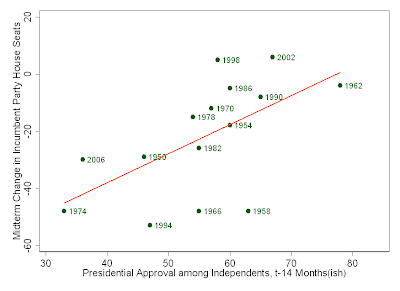
In fact, the two figures are virtually identical, as they should be, given that the correlation between approval among independents and the overall level of approval is .96 for this data series. At latest reading, Obama's approval rating among independents is 49% (is this "lopsided?"), just three points lower than his overall rating.
Finally, we turn to the generic congressional ballot. It is clear from other research that the generic ballot predicts well in the fall of election years (see Abramowitz), but is it really of much use 14 months out? In a word, no. The figure below plots midterm losses against the in-party advantage* on the Gallup generic ballot question, from 1950 to 2006:
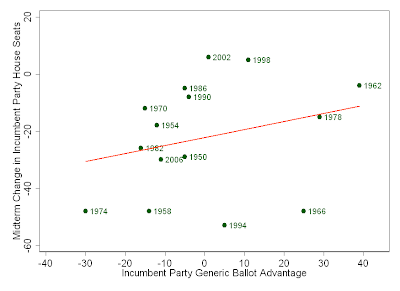 Although there appears to be a slight positive trend in these data, the pattern is not strong enough to generate very meaningful predictions (r=.27, p=.33).
Taken together, these data show that presidential approval 14 months prior to midterm elections has some predictive capacity, though there is enough error in the predictions that you shouldn't bet the farm. Approval among independents does not really add much to the predictions generated by overall approval, and the generic ballot this far out is not very useful at all. So what does this all mean for the 2010 elections? The picture is still fuzzy, but Cook is right to suggest that current conditions do not augur well for the Democrats. But I would still emphasize the fuzziness of that prediction and that it is based on presidential approval and not the generic ballot.
*It is difficult to get generic ballot data exactly 14 months prior to the midterm elections. In eleven cases, I was able to get data from 12 to 15 months out, while the remaining four cases used data measured appreciably close to the midterm elections.
With 14 months to go before the 2010 midterm election, something could happen to improve the outlook for Democrats. However, wave elections, more often than not, start just like this: The president's ratings plummet; his party loses its advantage on the generic congressional ballot test; the intensity of opposition-party voters skyrockets; his own party's voters become complacent or even depressed; and independent voters move lopsidedly away. These were the early-warning signs of past wave elections. Seeing them now should terrify Democrats.Given the time that remains between now and the 2010 elections, I was initially skeptical of Cook's warning to the Democrats, so I decided to examine some of the indicators cited by Cook. Although I'm not aware of good time-series data on out-party intensity or in-party complacence or depression, Gallup makes it is fairly easy to find data on presidential approval (for the general public and separately for independents), as well as on the generic congressional ballot. So, the question is, how well do these indicators predict midterm elections 14 months out? In other words, do current conditions necessarily provide clues to next year's congressional elections?
Let's look first at presidential approval. The figure below uses approval data from approximately 14 months (or as close as I could get) prior to midterm elections to illustrate the relationship between approval and seat change for the president's party:
Presidential Approval and Midterm Losses/Gains, 1946-2006

There appears to be positive pattern here but it is weak enough (r=.30) that the relationship is not statistically significant (p=.26). Of course, there is a lot of variation around the regression line, including some data points that are clear outliers; in particular, the 1946 election. In this case, Truman's approval was a sky-high 82% in October, 1945, just a few months after the end of WWII, but the Democrats went on to lose 54 seats in the midterm elections 13 months later. If we assume that Truman's approval was artificially and temporarily inflated and drop 1946, the patterns looks a bit tighter:
Presidential Approval and Midterm Losses/Gains, 1950-2006

Here it appears that early reports of presidential approval are fair predictors of midterm losses (r=.60, p=.02), though there are still a number of data points that are significantly off the regression line: 1958, 1966, and 1994 on the negative side, and 1998 on the positive side. Still, there is a clear relationship here, one that might foreshadow the outcomes of next year's elections. Based on the Obama's current level of approval (52%, Gallup polls in September), the trend in these data predicts a seat loss of 28 seats for the Democrats in 2010.
Should this be cause for Republican jubilation and Democratic hand-wringing? Not quite. The problem with forecasts like this one is that the sample size is small enough(n=15) and the forecasting error is large enough (standard error of forecast=17.9) that a 95% confidence interval around the prediction ranges from a loss of 67 seats to a gain of 11 seats. In other words, the prediction from these data encompasses everything from a complete Democratic collapse to historic gains for the Democrats. The best guess is still substantial Democratic losses, but with plenty of hedging.
What about Obama's standing among independents? Is it particularly important to the Democratic fortunes in the 2010 elections? It turns out that presidential support among independents is no more or less important than the overall level of presidential approval. Note that figure below (the relationship between presidential approval among independents and midterm losses) looks remarkable like the figure that used overall approval (above):
Presidential Approval Among Independents
and Midterm Losses/Gains, 1950-2006
and Midterm Losses/Gains, 1950-2006

In fact, the two figures are virtually identical, as they should be, given that the correlation between approval among independents and the overall level of approval is .96 for this data series. At latest reading, Obama's approval rating among independents is 49% (is this "lopsided?"), just three points lower than his overall rating.
Finally, we turn to the generic congressional ballot. It is clear from other research that the generic ballot predicts well in the fall of election years (see Abramowitz), but is it really of much use 14 months out? In a word, no. The figure below plots midterm losses against the in-party advantage* on the Gallup generic ballot question, from 1950 to 2006:
Generic Congressional Ballot and Midterm Losses/Gains, 1950-2006
 Although there appears to be a slight positive trend in these data, the pattern is not strong enough to generate very meaningful predictions (r=.27, p=.33).
Taken together, these data show that presidential approval 14 months prior to midterm elections has some predictive capacity, though there is enough error in the predictions that you shouldn't bet the farm. Approval among independents does not really add much to the predictions generated by overall approval, and the generic ballot this far out is not very useful at all. So what does this all mean for the 2010 elections? The picture is still fuzzy, but Cook is right to suggest that current conditions do not augur well for the Democrats. But I would still emphasize the fuzziness of that prediction and that it is based on presidential approval and not the generic ballot.
*It is difficult to get generic ballot data exactly 14 months prior to the midterm elections. In eleven cases, I was able to get data from 12 to 15 months out, while the remaining four cases used data measured appreciably close to the midterm elections.
Tuesday, March 10, 2009
What McCain was up against: The Economy
I just cracked open the initial release of the 2008 ANES data and thought I'd begin by focusing on economic evaluations. What the data show is something I think we all had a sense of at the time, but the pattern of economic evaluations is pretty dramatic nonetheless. Here's a look at the distribution of retrospective economic evaluations (national economy over the past twelve months) from the pre-election survey:
 As you can see, economic retrospections were decidedly negative, with fully 89% rating the economy as "somewhat" or "much" worse than a year ago. Moreover, virtually no one (3%) rated the economy as doing better, and only 9% said it was the same as a year before. The best way to fully appreciated the negativity of these economic attitudes is to compare the distribution of responses in 2008 to other years:
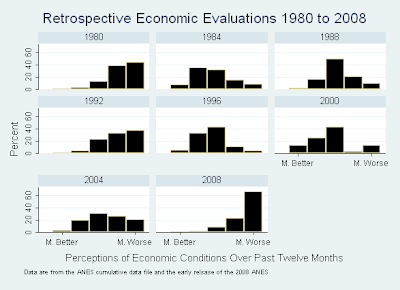 Here we see that 2008 stands out in two important ways: the overall level of negativity and the near uniform agreement about economic conditions. Economic evaluations were generally negative in a couple of the other years (1980, 1992), but even in those cases there was more variation around the mean outcome. McCain was up against a very negative economic environment and there was widespread agreement about that environment.
In fact, given the lack of variation in economic attitudes, it occurred to me that even Republicans must have expressed a high level of negativity. Here are are the data broken down by party affiliation:
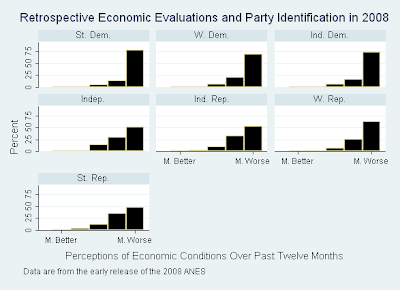 Sure, there is a tendency for Democrats to be more negative than Republicans, but "much worse" is the modal response in every partisan category, and fully 83% strong Republicans rated the economy as either "somewhat" (35%) or "much" (48%) worse.
There's a lot more to look at here and I'll try to follow up with other angles on the economy and the 2008 election.
 As you can see, economic retrospections were decidedly negative, with fully 89% rating the economy as "somewhat" or "much" worse than a year ago. Moreover, virtually no one (3%) rated the economy as doing better, and only 9% said it was the same as a year before. The best way to fully appreciated the negativity of these economic attitudes is to compare the distribution of responses in 2008 to other years:
 Here we see that 2008 stands out in two important ways: the overall level of negativity and the near uniform agreement about economic conditions. Economic evaluations were generally negative in a couple of the other years (1980, 1992), but even in those cases there was more variation around the mean outcome. McCain was up against a very negative economic environment and there was widespread agreement about that environment.
In fact, given the lack of variation in economic attitudes, it occurred to me that even Republicans must have expressed a high level of negativity. Here are are the data broken down by party affiliation:
 Sure, there is a tendency for Democrats to be more negative than Republicans, but "much worse" is the modal response in every partisan category, and fully 83% strong Republicans rated the economy as either "somewhat" (35%) or "much" (48%) worse.
There's a lot more to look at here and I'll try to follow up with other angles on the economy and the 2008 election.
Friday, January 2, 2009
Cold Water
December 31 was my birthday and it marked the passing of another decade of life (hint: I received a membership card from a powerful organized interest the day before my birthday). A few weeks earlier my kids decided that I needed to mark the occasion in grand fashion, so they convinced me to participate in the annual New year's Day Polar Bear Plunge into Lake Michigan. I agreed, figuring I could worm my way out of it somehow. Unfortunately, too many people had been told about it and had pledged to show up to cheer me on, so I had to take the plunge.
Other than floating chunks of ice that cut up my legs, and toes and fingers that I thought would never get warm again, it was really pretty fun. In fact, it was what I would call a real happening. The fire department (on hand to pull out frozen sinkers) estimated that there were about 2000 plungers and another 2000 people on hand to watch. It was a really party atmosphere.
Anyway, here are a few pics that summarize the experience:
Well wishers and support groups were on hand with fires, tents, and alcohol. I'd say there were a couple dozen fires:

This is what I saw (below) as I got ready to jump in. At this point it occurred to me just how cold I was about to be.

Of course I was heartened by the site of rescue personnel. Note the icebergs about twenty yards from shore:

Brace yourself; that's me (below) on the way in. Note the floating ice debris. That stuff really hurts. I'd say I was in for about 15 seconds. Getting out was the hard part, as the ice ledge kept crumbling.
 Here I am with my kids, and several layers of clothes, about ten minutes after getting out. As we walked to the car my daughter said, "Dad, I don't think you realize just how cold I am." Kids can be so sweet sometimes!
 Anyway, it was a hoot. Happy New Year!
PS: I suppose I'll get around to posting about politics again sometime soon.
Other than floating chunks of ice that cut up my legs, and toes and fingers that I thought would never get warm again, it was really pretty fun. In fact, it was what I would call a real happening. The fire department (on hand to pull out frozen sinkers) estimated that there were about 2000 plungers and another 2000 people on hand to watch. It was a really party atmosphere.
Anyway, here are a few pics that summarize the experience:
Well wishers and support groups were on hand with fires, tents, and alcohol. I'd say there were a couple dozen fires:

This is what I saw (below) as I got ready to jump in. At this point it occurred to me just how cold I was about to be.

Of course I was heartened by the site of rescue personnel. Note the icebergs about twenty yards from shore:

Brace yourself; that's me (below) on the way in. Note the floating ice debris. That stuff really hurts. I'd say I was in for about 15 seconds. Getting out was the hard part, as the ice ledge kept crumbling.
 Here I am with my kids, and several layers of clothes, about ten minutes after getting out. As we walked to the car my daughter said, "Dad, I don't think you realize just how cold I am." Kids can be so sweet sometimes!
 Anyway, it was a hoot. Happy New Year!
PS: I suppose I'll get around to posting about politics again sometime soon.
Tuesday, November 4, 2008
Final Forecasts
The table below summarizes various models I've worked with this fall, as well as the projections of two of my undergraduate classes. All of these projections point to a big night for Obama. I have the most confidence in the Electoral College forecast from the October model, and I expect the (two-party) popular vote to come in somewhere between the October model (53.9%) and my PS/APSA model (55.7%).
 It's interesting to note that both of my undergraduate classes independently came to the same conclusion: Obama 228 electoral votes, to McCain's 200. Their electoral maps are exactly the same as Karl Rove's map.
 It's interesting to note that both of my undergraduate classes independently came to the same conclusion: Obama 228 electoral votes, to McCain's 200. Their electoral maps are exactly the same as Karl Rove's map.
Monday, November 3, 2008
Paths to 270
In addition to my post on leading indicators to watch for tomorrow night, check out Jay DeSart's summary of the "paths to 270."
Subscribe to:
Posts (Atom)


